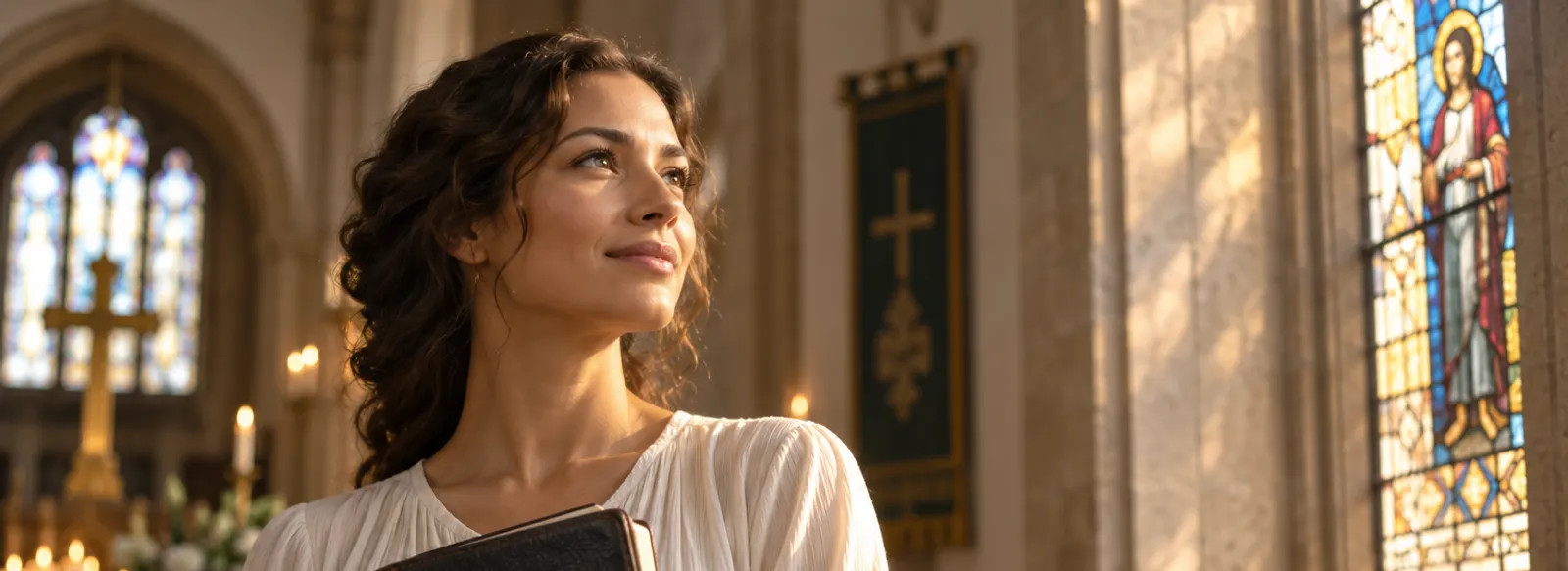
“I will make a helper suitable for him.”
Genesis 2:18 (NIV)
What happens when Christianity's sleeping force awakens? What happens when the Deborahs rise?
From the beginning, God declared that it was not good for man to be alone. He had given Adam a garden to cultivate and keep, but God knew the task required more than one kind of strength. So He made a helper suitable for Adam.
For centuries, however, the word helper has sometimes been reduced to the idea of a domestic assistant—as though God's design placed women on the sidelines of history.
But Scripture presents a much broader picture.
When the world was at war, women became visible.
History itself offers us an illustration.
During World War I, societies were forced to reconsider assumptions about what women could contribute. With millions of men serving at the front, women entered areas of national life previously dominated by men.
They worked in munitions factories, agriculture, transportation, communications, medicine, and public services. Organizations such as the Women's Land Army and groups popularly known as the Hello Girls demonstrated that women could serve their nations in ways many societies had previously underestimated.
The lesson was greater than the war:
When a nation refuses to use the strength available to it, it weakens itself.
Now consider Christianity.
What if the Church has been sleeping on a tremendous force God placed within it?
What if the Deborahs are still there—but many of them have never awakened?
Perhaps the church is waiting for its own version of World War I to fully grasp what ‘suitable helper’ means. However, if you haven’t noticed, Christianity has been on the front lines from the beginning.
Christianity has always been engaged in a battle.
Christianity was never intended to be a spectator movement.
Israel was instructed to eat the Passover while ready to move—sandals on their feet and belongings prepared (Exodus 12:11, NIV). Jesus spoke of bringing fire to the earth (Luke 12:49, NIV). Scripture describes the kingdom of God as advancing despite opposition (Matthew 11:12, NIV).
Yet our battle is not against people.
Paul reminds us that our struggle is “not against flesh and blood” (Ephesians 6:12, NIV).
The Christian mission involves confronting darkness with truth, injustice with righteousness, despair with hope, and deception with the light of Christ.
And if there is a battle, the Church needs every gift God has placed among His people.
We need the Deborahs.
When the men could not rise, Deborah rose.
The story of Deborah is one of the clearest reminders that God can raise up a woman to accomplish an assignment others have failed to fulfill.
The book of Judges tells us that Deborah was a prophetess and a judge in Israel. When Israel was suffering under oppression, she arose and summoned Barak.
And Deborah did not merely hold a symbolic position.
She acted.
She judged Israel. She spoke God's word. She mobilized Barak. She went with him toward battle. And when Barak hesitated, Deborah told him that the honor of victory would ultimately go to a woman.
God was not confused about whom He was using.
When men delayed, God did not stop moving.
What about Christian women?
This is where the Church needs deeper reflection.
Human life originates from the union of two spirits: the groom and the bride. Together, they create life itself. Their separation is true death, also known in the Bible as the ‘second death’ or ‘lake of fire’.
The human spirit is a complex unity, often described as a trinity of three ‘cities’ in one, yet it will ultimately collapse (Revelation 16:19, KJV). All creation fears this separation (Matthew 8:29; James 2:19) because it signifies being consumed by relentless flames of desire yet lacking the power to bring it to life (a lake of fire), as both the groom and the bride need each other for vitality.
The ‘second death’ is how God will put an end to sin across all worlds (1 Corinthians 15:26, NIV). Although they will burn endlessly in unquenchable flames of desire, no one will be able to sin anymore because of separation. True Christians will be exempt from this (Revelation 20:6 NIV) because they received a divine Groom at the first resurrection (repentance).
According to the spiritual reality of the groom and bride spirits, a woman has no true glory, life, or spirituality apart from the man. This is why the law incorporated this principle (1 Corinthians 14:34, NIV).
In the Old Covenant, women were excluded from the priesthood because of their nature. Today, Christians have a new priesthood (Hebrews 7:12, 16-19, NIV), and Christianity is a spiritual kingdom (John 18:36, NIV).
The New Testament emerged within cultures where social expectations regarding women were deeply entrenched. That is why we have Bible texts from the apostles that reflect those expectations.
Yet as the gospel unfolded, their understanding deepened, and God's work repeatedly challenged assumptions about who could receive, carry, and proclaim His grace.
The same Apostle Paul later declared:
“There is neither Jew nor Greek, slave nor free, male nor female, for you are all one in Christ Jesus.” — Galatians 3:28 (NKJV)
This does not erase the differences between men and women, nor does it imply that every biblical role or responsibility is identical.
But it does establish something fundamental:
Our standing before God is not determined by our earthly category.
In Christ, women are not second-class citizens in the Kingdom.
They are ‘daughters’ of God, heirs to His promises, recipients of the Holy Spirit, and participants in His mission.
God has done this before.
Consider the daughters of Zelophehad.
In Numbers 27, five daughters approached Moses about their father's inheritance. Zelophehad had no sons, and under the existing inheritance arrangement, their family line seemed to have no provision.
God responded by changing how the inheritance regulation was enforced.
That is significant.
It shows that some regulations in Scripture addressed specific structures and circumstances rather than establishing that women are inherently incapable of receiving responsibility, inheritance, or a divine purpose.
God Himself instructed Moses to acknowledge their claim.
The principle is powerful:
A structure designed for a particular circumstance must never be used as an excuse to deny what God Himself has permitted.
That does not mean every biblical command is negotiable. Scripture contains moral commands that remain binding.
But we must learn to distinguish between God's moral character and the regulations governing particular social structures.
When God moves ahead of our understanding.
There is a pattern throughout Scripture.
Sometimes God's people were slow to understand what God was doing.
When the apostles struggled to understand that Gentiles could fully belong to God's people, God poured out the Holy Spirit upon Cornelius and his household.
The apostles then had to recognize what God had already revealed (Acts 10:45-48, NKJV).
Sometimes God moves first.
Then our understanding catches up.
Perhaps the Church must do the same regarding women's gifts and contributions.
Not by abandoning Scripture.
Not by ignoring God's design.
But by refusing to let cultural traditions outweigh Scripture.
Even the resurrection carries a message.
Consider Mary Magdalene.
After Jesus rose from the dead, He appeared to her. She was granted this honor before His first ascension (John 20:17, KJK).
She became one of the first to witness the risen Christ.
Think about the significance.
At a time when many societies did not regard women's testimony as equal to men's, God chose a woman to encounter the risen Lord and to bear the news to His disciples.
God could have chosen anyone.
He chose Mary.
The message was unmistakable:
God does not need our cultural limitations to fulfill His purposes.
Throughout Christian history, countless women have served Christ as missionaries, teachers, evangelists, scholars, reformers, caregivers, writers, intercessors, and community leaders.
Some were celebrated.
Others were resisted.
Some were remembered.
Others were buried beneath the assumptions of their era.
And perhaps that is one of the questions the Church must face today:
How many Deborahs have we buried—not because God rejected them, but because we misunderstood them?
A woman does not need to become a man to be powerful.
This is where we need balance.
The answer is not to tell women, “You must become men before God can use you.”
Nor is it to pretend that men and women are identical.
They are not.
Men and women have distinct biological and psychological characteristics, and Scripture recognizes distinctions in family relationships and responsibilities (Ephesians 5:33 and Colossians 3:18-21, NIV).
But difference does not imply inferiority.
A helper is not necessarily a lesser person.
In fact, the biblical concept of helper is far richer than the modern notion of a servant who merely assists someone else's ambitions. The same Hebrew word appears in contexts where God Himself is described as the helper of His people.
So perhaps we have misunderstood the word.
The woman was not created to be man's servant.
She was created to be his ideal counterpart—someone whose strength complements his.
Deborah did not steal Barak's seat
This is perhaps the most important point.
Deborah did not need Barak's seat.
She had her own assignment.
And Barak still had his.
The Kingdom of God does not need a competition between men and women.
It needs cooperation.
Women do not need to become men.
Men do not need to become women.
And the Church does not need to erase all distinctions between them to recognize the enormous contributions women can make.
Women need their own seats at the table.
Not as decorations.
Not as tokens.
Not merely to fill a quota.
But as people who carry gifts, wisdom, courage, creativity, compassion, leadership, and spiritual capacity to bless the Church and transform nations.
Wake up, Deborah!
Imagine what would happen if Christian women everywhere awakened to their God-given calling.
Imagine women who refuse to be defined solely by cultural expectations.
Women who raise godly families and influence their communities.
Women who pray and build.
Women who nurture and lead where God has called them.
Women who teach, create, serve, organize, innovate, evangelize, and defend the truth.
Women who enter education, medicine, business, science, government, media, humanitarian work, and every legitimate field where their gifts can serve humanity and truth.
Imagine Christian women who understand:
You do not need to compete with men to prove your worth.
You do not need another person's position to validate your calling.
You need to discover the assignment God has given you.
The sleeping force must awaken.
The nations face significant challenges.
The Church cannot afford to waste nearly half of its potential.
If God has placed gifts among women, the Church should not bury those gifts beneath fear, tradition, or misunderstanding.
And if God has called a woman to an assignment, no man should feel threatened by her obedience to God.
Deborah did not diminish Israel's men.
She helped awaken them.
Perhaps that is what the Church needs today.
Not men fighting women.
Not women fighting men.
But men and women standing together under Christ, each faithfully fulfilling the responsibilities God has entrusted to them.
Because the question is no longer simply:
“Can a woman do this?”
The deeper question is:
“What has God called her to do—and are we courageous enough to let her do it?”
The nations are waiting.
The Church is waiting.
There are gifts sleeping.
Voices are waiting to be heard.
There are Deborahs waiting to rise.
Wake up, Deborah.
Your generation needs you.
Christianity needs you.
And perhaps the nations need the strength God placed within you more than you realize.
Psalm: Wake up, Deborah
Wake up, Deborah, The hour calls, The battle rages, The darkness falls.
You were not created To merely stand by; God placed fire within you, And courage in your battle cry.
When others were silent, Deborah arose; When strength seemed forgotten, She stood against foes.
She did not steal Barak's place, Nor did she fight for his seat; She simply embraced Her own calling.
You are not a shadow, Nor someone's spare hand; You are God's own vessel, Prepared for His plan.
The Church needs your wisdom, The nations need your light, Your prayers and courage, Your voice for what’s right.
You don't have to become What you were never meant to be; God's purpose is written In who He made you to be.
So rise, O Lioness, Let sleeping gifts wake; There are nations waiting, And lives at stake.
Not for competition, Not for honor or fame— But to serve God's Kingdom And to glorify His name.
The hour is upon us. Revival has begun. Let women and men rise, Together as one.
Wake up, Deborah. Let courage arise. The God who called you Still calls from the skies.
The battle awaits. The harvest is vast. Rise to your calling— And walk by His side.
Amen.